
The Controller: the Wise Man (or Woman) of the Woods
Roger Thetford writes…
Although planning is the best job in orienteering, controlling runs it close. It’s also less time-consuming: in the two years since retiring (mostly) from paid employment I’ve planned two events (plus some MapRuns) but have controlled ten and mentored one more. Even with my extra leisure time, I couldn’t have planned ten regional or national events!
The planner and organiser do most of the work to set up an event. The controller represents the competitor, aiming to ensure that everything runs smoothly and the competitor has an enjoyable and satisfying day. The main job is checking that the courses are fair and appropriate, with the right controls are in the right places, but there’s more to it than that.
Level D (local) events don’t need a controller, although they may have one, particularly to mentor an inexperienced planner. Controllers for levels C, B and A events are appointed respectively by clubs, regions and a national committee. They are usually from a different club or region, to provide independent oversight. This independence fosters cross-fertilisation of ideas — for example, a couple of Bristol events that I controlled used the TVOC system for logging fly-by finishes, and BOK is now investigating one of its own. Much better than having to punch at the finish!
When agreeing to control an event, I’ve usually but not always known who the planner is. Working with old friends is generally a pleasure; working with someone new can be a challenge. Novice planners need guiding in the right direction, but the most challenging can be people with fixed but ‘unconventional’ ideas. Sometimes they’ll respond to a reasoned argument, but not always!
The controller’s role is to guide, not to plan — the courses remain the planner’s. The only power of compulsion is that if something is unacceptably dangerous, the controller can refuse to sign off the risk assessment. I’ve had to do this only once. More satisfying is making a suggestion to improve one course, and the planner themselves realising that they can use the same idea to improve several other courses.
Having agreed which courses to offer, we’ll use results from previous events (either on the same or on similar areas) to work out roughly how long they should be, correcting for climb. I generally review first-draft courses from home, then ask the planner to tweak where necessary and tape the sites for draft 2. I then make one or more solo visits to check that the sites are clear and fair and that the map is accurate. If I can’t find the planner’s tape (and sometimes they do go missing, particularly on the paths) then I’ll tape what I think is the correct site. If the planner disagrees, or can’t find my tape, then we’ll make a joint visit to resolve things.
The CheckSites function in MapRun can be helpful here, although the base map must be correctly georeferenced. When checking sites for Croeso 2024 at Merthyr Common I made my way to the start, expecting good accuracy as there were no trees to interfere with the GPS signal, but couldn’t get a buzz from my watch. It turned out that the National Grid coordinates had been declared as lat / long in the OCAD base map, so to get a buzz I’d have had to be somewhere just off the coast of Equatorial Guinea. Even with correct georeferencing, GPS aids should be used only as back-up— the competitor will have just the printed map, so the controller needs to check that they can navigate to the site using only that map.
I’ll ensure that the loops for the white and yellow courses work properly on the ground, with the paths and junctions being clear and correctly mapped; faint paths may need taping. I may also test-run a course to check the length. Familiarity with the terrain roughly balances the drawbacks of looking for tapes rather than kites, and the lack of race adrenaline. At one event, conditions were faster than expected and the proposed Short Blue course became Green, with everything longer also moving down a slot.
Between the forest fun and the event itself comes a lot of checking. Descriptions must be accurate, and updated if things change. Numbers must be carefully positioned, circles and lines must be broken to avoid obscuring detail — including, for an urban area, showing that particular features are uncrossable. (Putting a white outline around numbers is particularly problematic: as well as obscuring extra detail, the outline can create an apparently legitimate route through an uncrossable wall.) The print area and the positioning of the control descriptions should give the competitors tolerance to take sub-optimal but valid route-choices or to make reasonable errors without ending up off the map or under the control descriptions. Managing change is crucial; shared online folders help to ensure that updates don’t get lost during email exchanges.
The final details should be as short as possible but be accurate. Postcodes aren’t great in rural areas, so you may have to lie to get competitors approaching from the desired direction. What3Words is much better.
On the day itself, all the SI units need to be woken and checked, and placed if they weren’t put out the day before. I prefer to check and wake all the units myself, but sometimes the distance to be covered and/or the available daylight doesn’t permit that. In that case usually the planner will have some help from one or more control-hangers, and we’ll produce a hanging plan that ensures that each control is hung and checked by two different people, one of whom will be the planner or me.
With everything in place the planner and controller can hope to relax for a while, before heading into the forest to observe competitors in action or to download to seek feedback on the courses. But if controls go missing then this idyllic peace can be shattered, as the event team scrambles to identify the gaps, inform the competitors and replace the missing units. At Crabtree Hill last November, 10 controls were vandalised between being checked and the first competitors starting to go through: some had been removed completely, some ‘merely’ had the boxes stolen. The control collectors found just one of the missing SI boxes, so that was a £900 loss for B OK. Tyre tracks on one of the rides showed that a powered bike had stopped at one of the vandalised controls and then accelerated away; the photographic evidence (below) was passed to the police along with the W3W location of this crime scene.
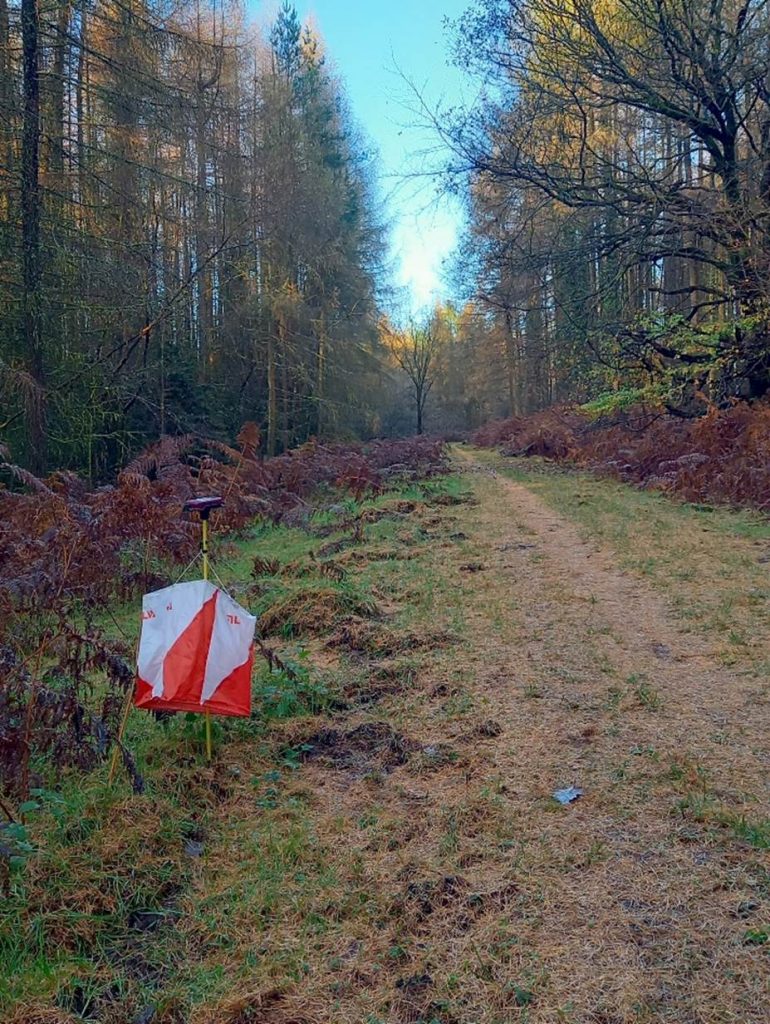
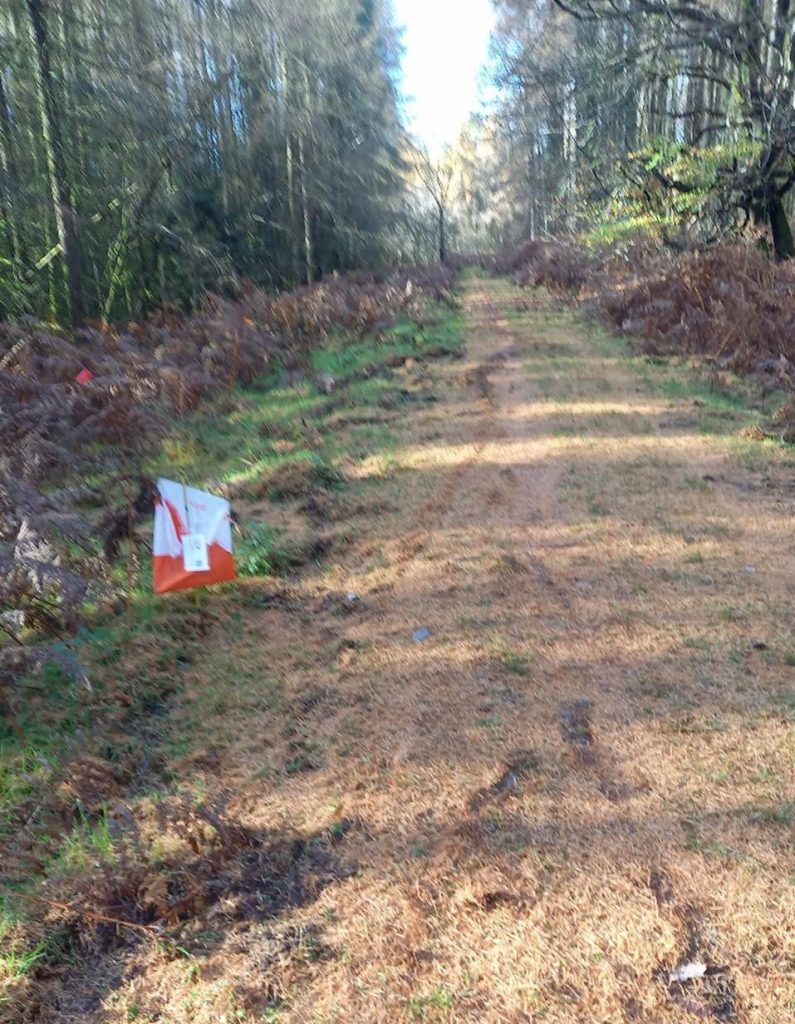
The crime scene: left at 08:37; right, 11:48 (sorry about the blurriness).
The organiser rather than the controller deals with any complaints, but the controller can offer (hopefully) wise counsel to both a disgruntled competitor and the organiser. If the competitor disagrees with the organiser’s decision then the matter will go to the jury: three qualified controllers who weren’t involved in staging the event. I’ve been appointed to many juries but only twice have had something to do — but that’s another article.